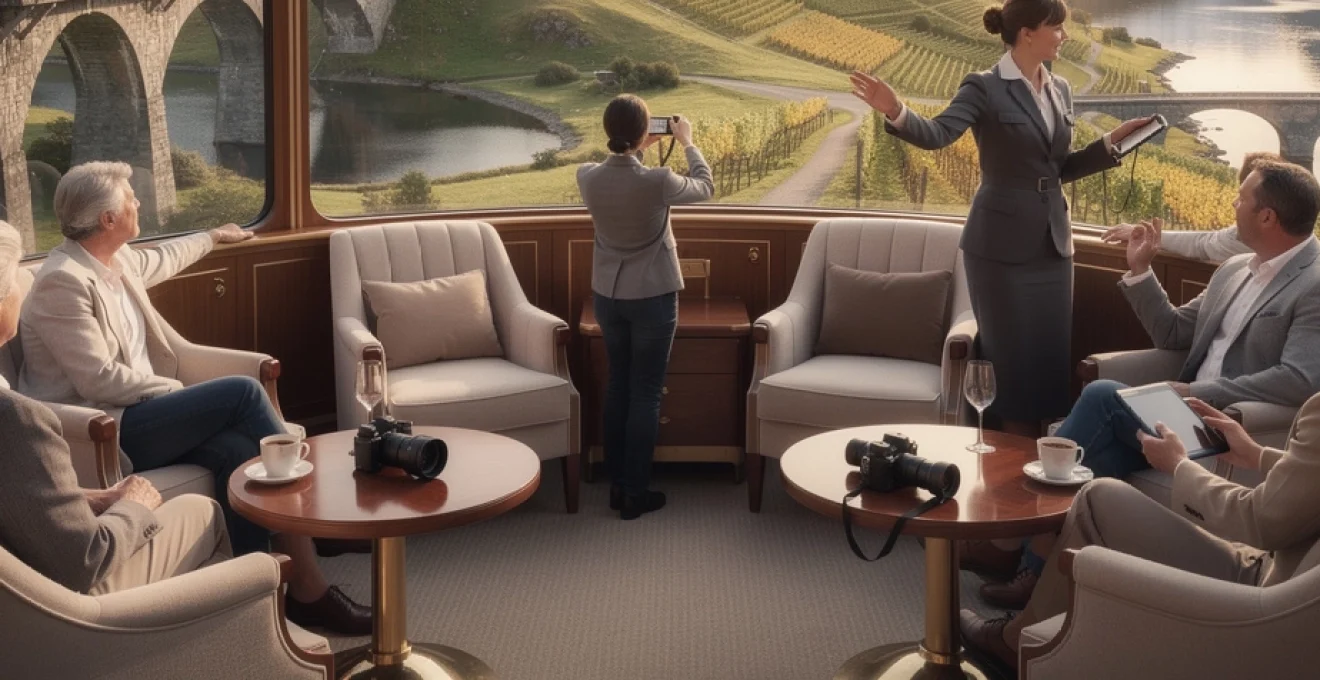
# Why Luxury Train Journeys Offer a Unique Way to See Scenic Landscapes
The romance of rail travel has experienced a remarkable resurgence in recent years, as travellers increasingly seek authentic, immersive experiences that transcend the hurried pace of modern aviation. Luxury train journeys represent far more than mere transportation—they offer a mobile observatory through some of the world’s most breathtaking terrain, where the journey itself becomes the destination. Unlike aircraft that hurtle passengers above landscapes at 35,000 feet or motor coaches confined to tarmac ribbons, trains glide through environments with an intimacy and perspective that transforms observation into genuine connection. The marriage of engineering ingenuity, strategic route selection, and thoughtful service design creates viewing experiences that simply cannot be replicated through any other mode of travel.
This unique positioning—neither too fast nor too detached—allows you to witness dramatic shifts in topography, vegetation, and light in real time. From your vantage point aboard these rolling palaces, mountain ranges unfold in symphonic progression, coastal vistas stretch endlessly along azure horizons, and remote wilderness areas reveal wildlife undisturbed by human presence. The deliberate pacing, combined with purpose-built observation facilities, creates what photographers call the “golden ratio” of landscape appreciation: close enough to discern detail, distant enough to comprehend scale, and moving at precisely the right velocity to maintain visual interest without inducing disorientation.
Panoramic observation carriages: engineering marvels for unobstructed landscape viewing
The technological innovation behind modern luxury train observation carriages represents decades of refined engineering focused on a singular objective: maximising your visual connection with surrounding landscapes. These specialised carriages employ advanced materials, structural design principles, and climate control systems that would have seemed fantastical to railway pioneers a century ago. Contemporary observation cars incorporate multi-layered glazing systems that eliminate glare whilst maintaining optical clarity, structural reinforcements that support expansive glass panels without compromising safety, and sophisticated suspension systems that minimise vibration for steady viewing even at elevated speeds.
The investment required to design and construct these observation platforms often exceeds £2 million per carriage, reflecting the complex interplay of safety regulations, passenger comfort requirements, and aesthetic ambitions. Engineers must balance competing demands: larger windows increase weight and structural vulnerability, yet smaller apertures diminish the very viewing experience that justifies the journey. The solution lies in composite materials, advanced glass technologies, and computer-aided design that optimises every millimetre of the viewing envelope.
Glass-domed vista lounges on the rocky mountaineer’s GoldLeaf service
The Rocky Mountaineer’s GoldLeaf Service carriages feature double-decker observation domes constructed from laminated glass panels that curve seamlessly overhead, creating an almost 360-degree viewing experience. These architectural achievements extend viewing angles to encompass not merely horizontal vistas but also towering cliff faces, cascading waterfalls, and the dramatic play of clouds across mountain peaks. The upper-level observation dome accommodates between 72 and 76 passengers depending on configuration, with seats arranged to ensure every position offers unobstructed sightlines.
What distinguishes this design is the integration of UV-protective coatings that block 99.9% of harmful ultraviolet radiation whilst maintaining complete colour fidelity—a critical consideration when traversing high-altitude routes where UV exposure increases significantly. The climate control system maintains comfortable cabin temperatures even when exterior conditions swing between -15°C in shaded canyons to direct sunlight capable of creating greenhouse effects within glass-enclosed spaces. Acoustical engineering further enhances the experience by incorporating sound-dampening materials that reduce track noise to conversational levels, allowing you to appreciate the scenery without mechanical distraction.
Floor-to-ceiling windows in the glacier express panorama coaches
Switzerland’s legendary Glacier Express employs panorama coaches with windows extending from floor level to ceiling height, creating what railway enthusiasts describe as “travelling inside a photograph.” These expansive glass panels measure approximately 1.8 metres in height and span nearly the entire length of each carriage side, interrupted only by minimal structural supports. The engineering challenge lay in maintaining structural integrity whilst removing conventional wall sections—a problem solved through reinforced floor
reinforcements and hidden roof girders that distribute loads away from the glass. In practical terms, this means you can sit back in a generously padded seat and enjoy uninterrupted views of steep valleys, village church spires, and high Alpine passes without the usual visual clutter of bulkheads and narrow panes.
For travellers interested in landscape photography, these panorama coaches are particularly compelling. The anti-reflective coating reduces internal reflections, while the slightly curved glass edges help minimise distortion at the periphery of your field of view. You can track the transition from sunlit slopes to shadowed ravines as the Glacier Express moves at a measured pace between Zermatt and St. Moritz, with the floor-to-ceiling windows effectively turning the Swiss Alps into a continuously scrolling IMAX screen. It is this combination of precision engineering and thoughtful interior design that demonstrates why luxury train journeys offer a unique way to see scenic landscapes in high fidelity.
Open-air viewing platforms on the napa valley wine train
While many luxury train journeys prioritise climate-controlled comfort, the Napa Valley Wine Train recognises that sometimes the most immersive way to experience a landscape is to remove the barrier of glass altogether. Several of its carriages feature open-air or semi-open viewing platforms, where waist-high railings and carefully engineered wind baffles allow you to stand outside safely as the train glides past vineyards, orchards, and hillside estates. The sensation is closer to being on the deck of a yacht than inside a conventional railcar, with the added benefit of the rhythmic motion unique to rail travel.
From a technical standpoint, these platforms must accommodate aerodynamic forces, noise levels, and safety regulations, all while remaining comfortable enough for guests to linger. Designers manage wind shear by shaping the carriage ends and installing partial canopies, reducing buffeting so you can raise a camera or a glass of Cabernet without struggle. Because the train operates at modest speeds along the Napa Valley corridor, you can pick up the scent of fermenting grapes, freshly cut grass, and warm earth—multi-sensory details that remind you how different luxury train travel feels compared to sealed aircraft cabins or highway coaches.
360-degree observation design of the bernina express carriages
The Bernina Express, operating between Chur and Tirano, takes the concept of panoramic viewing one step further through a carriage design that effectively offers 360-degree landscape immersion. Though the carriages are not literally transparent in all directions, the continuous side windows, large end windows, and cleverly aligned internal sightlines create an uninterrupted visual corridor from front to back. Wherever you sit, you can trace the arc of a viaduct, the sweep of a glacial valley, and the sharp outline of snow-capped peaks without needing to leave your seat.
To achieve this effect, engineers minimised internal bulkheads and used slim-profile seat backs that do not break up the view. Overhead luggage racks are integrated into the window framing rather than protruding into the cabin, preserving the open feel. This holistic design approach turns the carriage into a moving observatory, where you and your fellow passengers effectively share a single, continuous “cinematic screen” rather than peering through individual frames. For anyone seeking a luxury train journey focused on scenic landscapes, the Bernina Express illustrates how carriage architecture can be as important as the route itself.
Strategic route planning through UNESCO world heritage landscapes
Even the most sophisticated observation car is only as compelling as the scenery it traverses. Luxury train operators therefore invest considerable effort in strategic route planning, often aligning their itineraries with UNESCO World Heritage landscapes and other protected regions. Instead of simply connecting major cities in the fastest possible time, these routes deliberately meander through river gorges, high mountain passes, and cultural landscapes shaped by centuries of human activity. The result is an itinerary where almost every kilometre offers something worth looking at, not just the occasional highlight.
This approach reflects a core principle of luxury rail travel: the journey should be a curated experience rather than a mere transfer. Routes are selected and timed to maximise daylight exposure during the most visually striking segments, with night running reserved for less remarkable stretches wherever possible. In many cases, trains are granted track priority or special paths by national rail operators, allowing them to maintain favourable timings and viewing conditions. For you as a passenger, this means that “dead time” is kept to a minimum, and the windows frame one remarkable vista after another.
Traversing the albula and bernina railway lines across swiss alpine viaducts
The Albula and Bernina railway lines, part of the Rhaetian Railway in the Swiss Alps, collectively hold UNESCO World Heritage status due to their extraordinary marriage of engineering and landscape. Luxury and premium tourist trains such as the Glacier Express and Bernina Express exploit these lines to full effect, threading across stone viaducts, through helical tunnels, and along mountain ledges that would be inaccessible by road. Each curve and gradient has been calculated not only for operational feasibility but also for scenic drama.
Consider the famous Brusio spiral viaduct on the Bernina line. Instead of a straight climb that would be technically easier but visually dull, engineers designed a 360-degree stone loop that allows the train to gain altitude gradually while giving passengers a rare opportunity to see their own train circling beneath or above them. It is as if the route itself has been choreographed for maximum theatrical impact. The UNESCO recognition underscores how carefully planned routes transform luxury train journeys into living lessons in landscape architecture and mountain engineering.
Navigating scotland’s west highland line from fort william to mallaig
Scotland’s West Highland Line, particularly the section between Fort William and Mallaig, demonstrates how route planning can turn even a relatively short journey into an epic visual narrative. Luxury and heritage services, including the Jacobite steam train, time their departures to coincide with optimal lighting across landmarks such as Ben Nevis, Loch Eil, and the famous Glenfinnan Viaduct. Instead of skirting the rugged terrain, the line plunges into the heart of it, hugging loch shores and crossing boggy moorlands on elegant stone and concrete structures.
From a traveller’s perspective, the genius of this alignment lies in its variety over a compact distance. Within a couple of hours, you transition from deep glens to open sea vistas, from dense forests to windswept headlands. For photographers, the slow curves across the Glenfinnan Viaduct offer ample time to frame shots reminiscent of cinematic scenes, while the train’s moderate speed ensures that even with a smartphone you can capture crisp images. It is a prime example of how luxury rail experiences leverage classic lines to provide access to some of Europe’s most evocative landscapes without requiring strenuous hikes or self-driving on single-track roads.
Crossing the landwasser viaduct and oberalp pass at reduced velocities
On several flagship Swiss routes, including the Glacier Express, train operators intentionally reduce speed when traversing signature features such as the Landwasser Viaduct and the Oberalp Pass. While modern rolling stock could technically cross these segments more quickly, doing so would undermine the very reason many passengers board these trains: to savour the spectacle. Operators therefore schedule slight speed restrictions and, in some cases, short pauses to allow everyone ample time to appreciate the setting.
The Landwasser Viaduct, a six-arch limestone structure soaring 65 metres above the valley floor, is a case in point. As the train slows, you can observe not only the depth of the gorge below but also the way the line plunges directly into a tunnel bored into the vertical cliff face—a sequence that feels almost surreal when viewed in real time. Similarly, on the Oberalp Pass, the gradual pace allows you to absorb the transition from forested valleys to stark high-altitude plateaus where snow lingers well into spring. These micro-adjustments in velocity illustrate how speed control is used as a tool for visual storytelling, not just timetable adherence.
Following the douro valley vineyards on the presidential train route
In Portugal, the historic Presidential Train traces a route along the Douro Valley, a UNESCO-listed cultural landscape renowned for its terraced vineyards and quintas (wine estates). Instead of taking the most direct path from Porto into the interior, the line follows the sinuous course of the Douro River, weaving from bank to bank to offer constantly shifting perspectives. This alignment ensures that you see the vineyards from multiple angles: from below, where stone retaining walls rise above the train, and from above, where the river gleams far below intricate patterns of vines.
The slow, looping route gives you time to notice details that would disappear in a blur at motorway speeds: workers tending vines by hand, traditional rabelo boats moored at small jetties, and whitewashed chapels perched on hilltops. Onboard wine tastings and curated commentary complement the scenery, turning what might otherwise be a picturesque regional line into an immersive luxury rail journey through one of Europe’s most distinctive wine-growing regions. For travellers who value both landscape and gastronomy, this is route planning at its most inspired.
Slow travel methodology: velocity control for enhanced visual immersion
One of the defining features of luxury train journeys is their embrace of slow travel methodology. Rather than competing with high-speed rail or aviation on pure velocity, these services intentionally operate at moderated speeds to maximise landscape appreciation and onboard comfort. This deliberate pacing reduces motion blur, prevents fatigue, and allows your brain to process complex vistas in real time—a bit like switching from the fast-forward button to a gentle, frame-by-frame playback.
From a technical perspective, operators balance commercial imperatives with experiential goals by using variable speed profiles along the route. Trains may move briskly through less scenic industrial approaches to cities, then slow considerably across mountain passes, coastal stretches, or heritage viaducts. The result is a rhythm that alternates between anticipation and contemplation, much like the tempo changes in a symphony. For you as a passenger, this means that when the most dramatic scenery arrives, the train is already travelling at a speed that invites you to linger visually, not simply glance and miss the moment.
The venice Simplon-Orient-Express’s 60 km/h average speed through alpine passes
The Venice Simplon-Orient-Express is perhaps the most iconic example of luxury rail’s commitment to unhurried elegance. While capable of running faster, the train’s average speed through Alpine sections often hovers around 60 km/h, with additional reductions on particularly scenic curves and viaducts. This is significantly slower than many modern intercity services, yet it is precisely this moderation that makes the experience so memorable. You have time to watch villages appear, drift past, and recede into the distance, rather than seeing them flash by like fleeting thumbnails.
At these speeds, the motion of the train feels more like a gentle rocking than a relentless surge, which also reduces fatigue on longer journeys. You can comfortably move to the bar car, linger over a multi-course dinner, or simply stand by a window without bracing yourself. For anyone curious about why luxury train journeys offer a unique way to see scenic landscapes, the answer is clear here: the slower the passage through dramatic terrain, the deeper the imprint on your memory. Much like walking through an art gallery instead of jogging, a moderated pace lets each “canvas” along the line be fully appreciated.
Scheduled photography stops on the eastern & oriental express itinerary
On select itineraries of the Eastern & Oriental Express between Singapore, Malaysia, and (historically) Thailand, the concept of slow travel is extended beyond speed limits to include scheduled photography stops. At certain bridges, river crossings, or jungle clearings, the train pauses or even allows guests to disembark briefly under controlled conditions. These interludes are not operational necessities; they are built into the timetable to accommodate the growing number of travellers who prioritise landscape photography and immersive observation.
From a planning standpoint, such stops require coordination with national rail networks, careful attention to safety protocols, and contingency buffers in case of delays. Yet the payoff is significant: rather than snapping hurried shots through a moving window, you can frame thoughtful compositions, capture long-exposure images of dawn mist over rice paddies, or simply stand in the tropical stillness listening to cicadas. These moments underscore how luxury rail operators increasingly view their journeys as experiential products, where time is a resource to be invested in passenger engagement, not just punctuality.
Extended dwell times at scenic waypoints along the canadian’s trans-continental route
VIA Rail’s flagship service, The Canadian, running between Toronto and Vancouver, exemplifies slow travel methodology on a grand scale. While not exclusively a luxury train, its Prestige and sleeper-plus classes offer a premium experience, and the timetable is deliberately structured with extended dwell times at particularly scenic waypoints. Stops in Jasper, Kamloops, or Winnipeg may last from 30 minutes to several hours, giving you the option to stretch your legs, explore local viewpoints, or join guided excursions.
These elongated pauses serve a dual purpose. Operationally, they allow the train to recover from delays on a busy freight corridor. Experientially, they transform a long-distance journey into a sequence of mini-destinations anchored in landscapes: the Canadian Rockies, the Prairies, the coastal ranges of British Columbia. It is akin to watching a multi-part documentary series where each episode opens with a fresh establishing shot. For travellers who equate value with both comfort and depth of experience, this approach makes a compelling case for choosing luxury train journeys over short, disjointed flights.
Elevated vantage points: track positioning through mountain terrain
Another reason luxury train journeys offer a unique way to see scenic landscapes lies in the strategic vertical positioning of the tracks themselves. In mountain regions especially, railways often occupy mid-slope terraces or cliff-hugging ledges that provide elevated vantage points unavailable to road users confined to valley floors. This elevation acts like a natural viewing platform, allowing you to see not only the immediate surroundings but also the wider geography—river systems, glacial formations, and settlement patterns—unfolded beneath you.
Designing such routes requires intricate surveying and, in many cases, the construction of tunnels, galleries, and avalanche sheds to protect both train and track. The effort is justified by the resulting panoramas: think of the Bernina line skirting high above Lago Bianco, or the Ghan cresting low ridges to reveal vast Australian desert plains stretching to the horizon. From your seat, the perspective is similar to that from a low-flying aircraft, yet without the altitude-induced detachment. You can still pick out individual trees, farmhouses, and animals, while appreciating the grand scale of the surrounding landscape.
Curated onboard commentary systems and expert-led landscape interpretation
Scenery alone, however impressive, gains additional depth when interpreted by knowledgeable guides and well-designed commentary systems. Many luxury train operators recognise that their guests are not just passive spectators but curious travellers keen to understand what they are seeing. To meet this expectation, they provide curated onboard commentary—sometimes live, sometimes via multilingual audio channels—that explains geology, ecology, history, and local culture in accessible language.
This interpretive layer turns the train into a moving classroom, where each valley, plateau, or wildlife sighting is contextualised. Why does a particular mountain have its distinctive shape? How did a river carve such a deep gorge? What historical events unfolded along this stretch of track? By addressing these questions, commentary transforms visual impressions into lasting knowledge. It is the difference between simply seeing a landscape and truly reading it, much as an art historian’s insights can change how you experience a painting.
Real-time geographic analysis on the blue train’s karoo crossing
South Africa’s Blue Train, renowned for its opulent suites and fine dining, also offers a sophisticated commentary experience, particularly during its crossing of the Karoo semi-desert. As the train traverses this vast, seemingly empty expanse, real-time geographic analysis delivered via onboard screens and periodic announcements highlights subtle features that you might otherwise overlook: ancient riverbeds, fossil-rich strata, and the gradual transition from scrubland to cultivated fields near human settlements.
The effect is akin to having a geologist and historian travelling with you, pointing out details through the window as they appear. References to local climate data, biodiversity statistics, and conservation projects help you appreciate the fragility of the ecosystem beyond the tracks. For many guests, this depth of interpretation shifts the Karoo from “empty space” to a richly layered landscape, reinforcing the idea that luxury train journeys are not only about comfort but also about meaningful engagement with the regions they traverse.
Naturalist-guided wildlife spotting through india’s western ghats on the deccan odyssey
On select itineraries of India’s Deccan Odyssey, particularly those that brush the edges of the Western Ghats, onboard naturalists accompany the journey to guide wildlife spotting and interpret the lush landscapes. As the train climbs through misty hillsides covered in teak and evergreen forests, these experts help you identify bird species, primates, and even big cats that may be visible from the carriage or during off-train excursions. It is somewhat like joining a safari, but with the added comfort of returning to a luxurious cabin rather than a tent.
This expert presence changes how you interact with the passing scenery. Instead of simply admiring “pretty green hills,” you begin to notice ecological zones, migration corridors, and endemic species. The naturalists weave in information about monsoon patterns, conservation challenges, and local communities’ relationships with the forest, turning each sighting into part of a broader narrative. For travellers seeking eco-conscious luxury experiences, this blend of high-end comfort and serious environmental interpretation is especially appealing.
Historical context narration along the ghan’s red centre journey
Australia’s Ghan, crossing the continent between Adelaide and Darwin, offers rich historical narration that anchors the stark beauty of the Red Centre in stories of exploration, Indigenous cultures, and railway construction. As the train passes through ochre plains, dry riverbeds, and low mountain ranges, commentary delivered in lounges or via personal devices recounts the history of Afghan cameleers (from whom the Ghan takes its name), early telegraph lines, and the resilience of Aboriginal communities in harsh desert environments.
This historical layer functions as a kind of audio map overlaying the terrain, helping you understand why certain towns emerged where they did, or how resources and climate shaped settlement patterns. When you step off in places like Alice Springs or Katherine for off-train tours, the earlier narration frames what you see on the ground, deepening your appreciation of both natural features and human stories. The result is a more nuanced connection to the landscape—one that lasts beyond the journey itself.
Multi-lingual audio systems detailing the flåm railway’s fjord formation
Norway’s Flåm Railway, though relatively short, packs an extraordinary amount of geological interest into its steep descent from Myrdal to the fjord village of Flåm. To ensure that international guests can fully understand the drama unfolding outside, the train offers multi-lingual audio commentary detailing the formation of the fjords, the role of glacial erosion, and the engineering feats required to build such a steep line. The system is synchronised with specific tunnels, waterfalls, and viewpoints so that explanations arrive just as the relevant features appear at your window.
For many travellers, this is their first encounter with glacial landscapes in such close proximity. Hearing how ancient ice carved U-shaped valleys, or how rockslides and avalanches have historically shaped local communities, transforms the spectacular view into a comprehensible story of deep time. The analogy often used is that of reading subtitles on a foreign film: you still enjoy the visual spectacle, but the text helps you grasp the underlying plot. In the context of luxury train journeys, this combination of scenery and smart audio design epitomises modern, guest-focused interpretation.
Seasonal route optimisation for peak landscape photography conditions
Timing is everything when it comes to scenic landscapes, and luxury train operators increasingly use seasonal route optimisation to ensure that their guests encounter each region at its visual best. This can mean scheduling departures to coincide with spring wildflower blooms, autumn foliage, or peak snow cover, as well as adjusting departure times within a day to capture sunrise and sunset light over iconic landmarks. For travellers passionate about photography, these considerations can be the difference between pleasant snapshots and truly memorable images.
In practical terms, seasonal optimisation involves analysing historical weather data, daylight hours, and tourism patterns, then mapping these against operational constraints such as track availability and maintenance windows. Some trains, like the Rocky Mountaineer, operate only during specific months when mountain passes are reliably open and daylight is plentiful. Others adjust their itineraries: a winter route might emphasise snow-clad forests and frozen lakes, while a summer variant highlights alpine meadows and accessible hiking excursions. For you, this means that whether you choose a winter wonderland journey or a summer mountain escape, the experience has been intentionally tuned to showcase each landscape at its seasonal peak.