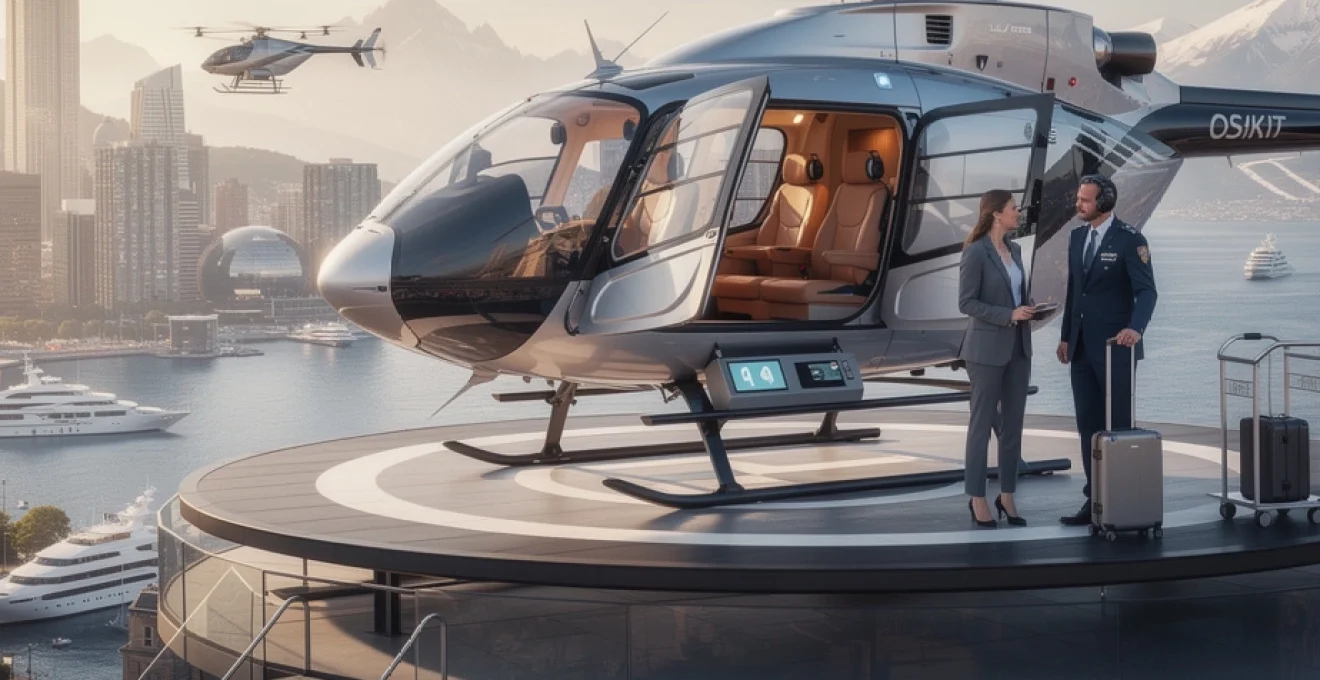
The roar of traffic, the endless queues, the frustration of watching minutes turn into hours—ground transportation has become synonymous with wasted time. Yet above the gridlock, a solution glides effortlessly through the skies. Private helicopter transfers have evolved from a luxury reserved for the ultra-wealthy into an increasingly accessible mode of executive transport that redefines efficiency. When a two-hour motorway slog transforms into a six-minute aerial journey, you begin to understand why savvy travellers are looking upward. This isn’t merely about status or spectacle; it’s about reclaiming your most precious resource: time. As urban congestion intensifies and business demands accelerate, the question isn’t whether helicopter transfers offer value—it’s whether you can afford not to consider them.
Rotorcraft charter operations: understanding private helicopter transfer services
Private helicopter charter operations function under stringent regulatory frameworks that ensure passenger safety whilst providing exceptional flexibility. Unlike commercial airline services bound by rigid schedules and limited destinations, rotorcraft charter companies offer bespoke point-to-point services that adapt to your itinerary rather than constraining it. These operations cater to corporate executives, high-net-worth individuals, and anyone seeking to bypass the inefficiencies of conventional travel. The sector has witnessed substantial growth over the past decade, with the global helicopter charter market projected to reach £11.8 billion by 2028, reflecting a compound annual growth rate of approximately 6.2%. This expansion demonstrates that helicopter transfers are transitioning from niche luxury to mainstream executive transport solution.
Part 135 air carrier certification and regulatory compliance
Every legitimate helicopter charter operation must comply with comprehensive aviation regulations. In the United Kingdom, operators require an Air Operator Certificate (AOC) from the Civil Aviation Authority, whilst American operators need Part 135 certification from the Federal Aviation Administration. These certifications mandate rigorous standards covering everything from pilot qualifications to aircraft maintenance protocols. Part 135 operations distinguish commercial helicopter services from private flights, establishing minimum safety thresholds that protect passengers. Operators must maintain detailed operational specifications, undergo regular audits, and demonstrate compliance with operational control procedures. For you as a passenger, this regulatory framework provides assurance that your charter company meets exacting professional standards—far exceeding the requirements for private recreational flying.
Fleet composition: robinson R66 vs airbus H125 vs bell 407GXi
Charter operators typically maintain diverse fleets to accommodate varying passenger requirements and mission profiles. The Robinson R66 represents an economical five-seat option ideal for short transfers, powered by a reliable Rolls-Royce RR300 turbine engine. Its glass cockpit and spacious cabin make it popular for airport shuttles and regional transfers, though its single-engine configuration limits operations in certain weather conditions. The Airbus H125 (formerly AS350) offers exceptional versatility with its powerful Arriel 2D engine, capable of high-altitude operations and external cargo configurations. This workhorse serves alpine resorts and remote estates with equal competence. At the premium end, the Bell 407GXi delivers corporate-level refinement with its wide-body cabin, advanced avionics suite, and notably quiet operation thanks to its four-blade rotor system. Your choice among these aircraft depends on passenger count, baggage requirements, and destination characteristics.
Point-to-point routing and helipads: london battersea to farnborough
Helicopter transfers excel at connecting urban centres with suburban or regional destinations via direct routing that ignores terrestrial obstacles. Consider the journey from London Battersea Heliport to Farnborough Airport—a route frequently travelled by business executives. By road, this 45-kilometre journey can consume 90 minutes during peak periods, navigating through southwest London’s congested arteries. A helicopter completes the same journey in approximately 12 minutes, flying directly over the urban sprawl at 1,000 feet. London Battersea, situated on the south bank of the Thames, operates under strict noise abatement procedures and maintains departure slots that ensure efficient operations. Farnborough offers dedicated helicopter landing areas adjacent to its private jet terminals, facilitating seamless air-to-air connections. This routing exemplifies how helicopters create time savings that compound throughout your journey, potentially enabling same
day returns between regional hubs that would be impossible using ground transport alone. When multiplied across a busy executive schedule or a packed events calendar, those saved minutes translate into reclaimed days over the course of a year.
Pricing structures: hourly rates and minimum flight time requirements
Helicopter charter pricing is typically based on an hourly rate, but the headline figure rarely tells the full story. Operators generally apply a minimum flight time per sector (often 30 or 60 minutes), even if your actual journey lasts only a fraction of that. This reflects not only air time but also positioning flights, pre-flight inspections, landing fees, and crew costs. As a result, a short urban hop can sometimes cost more per minute than a longer regional transfer.
For light single-engine helicopters such as the Robinson R66, rates in Europe and the US often start around £1,200–£1,600 per flight hour. More capable types like the Airbus H125 or Bell 407GXi frequently range from £1,800–£3,000 per hour depending on configuration and region. You may also encounter surcharges for night operations, de-icing in winter, or landing at premium heliports. The most cost-efficient way to use private helicopter transfers is to group itineraries, share flights with colleagues or family, and minimise repositioning segments where the aircraft flies empty.
Operational advantages over fixed-wing aircraft and ground transportation
When evaluated purely on cruise speed, helicopters cannot compete with private jets. However, real-world travel is rarely as simple as “block-to-block” air time. Helicopters excel in what logistics specialists call the “first and last mile”, cutting out the slowest, most unpredictable legs of any journey. They leapfrog road congestion, bridge bottlenecks, and the need to transit through busy airport terminals, often delivering a door-to-door experience that no other mode can rival. For time-sensitive travellers, the metric that matters is not knots or miles per hour but total journey time from where you are to where you need to be.
Urban congestion bypass: manhattan to JFK in 8 minutes
Few routes illustrate the advantage of private helicopter transfers better than the commute between Manhattan and John F. Kennedy International Airport. By car, this 25-kilometre journey can easily stretch to 60–90 minutes—or more—during rush hour or in poor weather. A helicopter transfer, by contrast, connects midtown Manhattan heliports to JFK in approximately 6–8 minutes of flight time. Even when you factor in a brief security screening and boarding, you can expect curb-to-curb times of around 20 minutes.
Urban air mobility providers have standardised this corridor, offering shared and private options throughout the day. Operating altitudes remain low enough to avoid airline traffic yet high enough to minimise noise footprints over residential areas. For frequent flyers who value predictability, this consistent journey time is transformative. You are no longer hostage to bridge closures, roadworks, or last-minute diversions; instead, you glide over the congestion and arrive at the terminal relaxed, with a comfortable buffer before departure.
Direct access to remote luxury destinations and private estates
Beyond cities, private helicopter transfers open up a world of destinations that fixed-wing aircraft cannot practically serve. Luxury lodges, remote vineyards, private islands, and countryside estates often lack runways but can accommodate a helipad or suitable landing site. In these scenarios, helicopters act as aerial four-wheel drives, bridging the gap between regional airports and truly off-grid properties. This ability to land close to your final destination can shave hours off itineraries that would otherwise require winding roads or boat transfers.
For property owners, a dedicated helipad becomes an amenity on par with a pool or tennis court, significantly enhancing accessibility and perceived value. From your perspective as a passenger, it means stepping from your villa terrace or yacht deck directly into the cabin and lifting off within minutes. No taxis, no road signs, no missed turns—just a straight line between where you are and where you want to be. It is this precision, as much as the comfort, that makes private helicopter transfers such an attractive upgrade to traditional luxury travel.
Time efficiency metrics: monaco grand prix weekend case study
Major events offer a useful lens through which to measure the true efficiency of helicopter transfers. Consider the Monaco Grand Prix weekend, when the Côte d’Azur’s roads become saturated with traffic. The drive from Nice Côte d’Azur Airport to Monaco typically takes 45–90 minutes; during peak race periods, even longer. A helicopter covers the same route in roughly seven minutes. Operators run near-continuous shuttles between the airport and helipads in Monaco and surrounding areas, often integrating with yacht tenders or private limousines.
From a time-efficiency standpoint, if you attend multiple sessions or hospitality events across the weekend, the savings compound rapidly. Instead of budgeting three or four hours per day for transfers, you may spend less than 40 minutes in total transit. For corporate guests, that additional time can be redirected to client entertainment or networking; for leisure travellers, it simply means more time enjoying the racing and the Riviera. When evaluating whether private helicopter transfers justify their cost, such event case studies demonstrate the tangible return on time.
Weather minimums and VFR vs IFR capabilities
One operational constraint that differentiates helicopters from business jets is weather sensitivity. Many private helicopter transfers operate under VFR (Visual Flight Rules), requiring sufficient visibility and cloud clearance to navigate safely. Think of VFR as driving with clear visibility on an open road—you can see obstacles and landmarks directly. In low cloud, fog, or heavy precipitation, VFR routes may be curtailed or delayed, particularly in mountainous or urban environments where terrain and obstacles are more complex.
Some twin-engine helicopters are equipped and certified for IFR (Instrument Flight Rules), allowing them to fly using cockpit instruments and air traffic control guidance, much like an airliner. IFR capability improves dispatch reliability but requires suitably equipped aircraft, qualified pilots, and approved approach procedures at departure and arrival points. For you as a passenger, it is worth asking your charter broker about the operator’s typical weather minimums and whether contingency plans—such as ground transport or schedule flexibility—are in place. A reputable provider will always prioritise safety over schedule pressure, even if that means delaying or re-routing a transfer.
Executive aviation interior configurations and passenger experience
The cabin of a modern helicopter may be more compact than that of a private jet, but it is no less considered. Manufacturers have invested heavily in executive interior options, transforming what was once a purely utilitarian space into a refined, comfortable environment. Seating layouts can be club-style for face-to-face conversations, or forward-facing for sightseeing routes, whilst bespoke upholstery, soundproofing, and ambient lighting all contribute to a premium feel. For journeys under an hour, the emphasis is on ergonomics and visibility rather than on-board movement or lie-flat rest.
Leather upholstery and noise-cancelling headset technology
Step into a contemporary executive helicopter and you are likely to find supple leather seats, polished trim, and carefully chosen colour palettes that mirror high-end automotive interiors. These materials are not only visually appealing but also functional, offering durability and ease of cleaning in a high-use environment. Seat ergonomics are designed to support passengers through climb, cruise, and descent, with ample legroom despite the compact cabin footprint. It is a deliberate blend of luxury and practicality tailored to short, high-intensity flights.
Rotorcraft, by their nature, generate more cabin noise than fixed-wing jets. To counter this, operators provide advanced noise-cancelling headsets for every passenger. These systems work like a volume dial on the outside world, using active technology to “subtract” engine and rotor sounds, allowing clear conversation and reducing fatigue. For many first-time passengers, the headset becomes part of the experience—offering not just comfort but also a sense of immersion as you listen to pilot communications or enjoy commentary on landmarks along the route. The result is a surprisingly relaxed environment despite the mechanical power at work just above your head.
In-flight connectivity: satcom systems and Wi-Fi limitations
Connectivity expectations have shifted dramatically in recent years, and many travellers now assume that Wi-Fi will be available whenever they fly. In private helicopters, the picture is more nuanced. Some larger twin-engine types can be fitted with satcom systems, providing voice and data links via satellite networks. However, the cost, weight, and installation complexity mean that full in-flight Wi-Fi is still relatively rare on short-haul helicopter transfers, especially on smaller single-engine models.
Instead, most passengers treat helicopter legs as brief offline interludes between connected segments of a journey. Flight times typically range from 10 to 45 minutes, during which you can review printed agendas, enjoy the view, or simply decompress. If continuous connectivity is critical—for instance, during high-stakes deal negotiations—it is worth discussing options with your operator. Some routes allow for limited use of mobile data at altitude, depending on network coverage and local regulations, but you should not assume that a helicopter cabin will mirror the always-on environment of a modern business jet.
Climate control and pressurisation constraints in helicopter cabins
Another key difference between helicopters and fixed-wing aircraft lies in cabin altitude and environmental control. Most executive helicopters operate unpressurised cabins and typically fly at lower altitudes, often between 1,000 and 5,000 feet above ground level. This avoids the need for oxygen systems and reduces physiological stress on passengers, but it does mean that flights are more exposed to outside temperature variations. Modern climate control systems manage this effectively on most routes, but you may still notice seasonal differences, particularly when doors are opened during boarding or quick turnarounds.
Think of the helicopter cabin more like a luxury SUV than a long-haul airliner: comfortable, well-ventilated, and temperature-controlled, but not designed for extreme altitudes or multi-hour cruise segments. For transfers in hot climates, operators can pre-cool cabins before boarding, whilst in colder regions, heated seats and efficient demisting systems maintain comfort. If you have specific requirements—such as travelling with young children or elderly relatives—it is sensible to brief your broker so they can select aircraft and seating positions that offer the smoothest, most sheltered ride.
Luggage capacity: external cargo pods vs internal baggage compartments
Luggage planning is one area where expectations set by private jets can lead to surprises on helicopter transfers. While jets often boast generous baggage holds, many light helicopters have more limited internal storage, designed primarily for cabin-sized bags and soft luggage. Hard-shell suitcases, golf bags, or extensive ski equipment can quickly consume available space, especially on five- or six-seat aircraft operating near maximum weight limits. As a rule of thumb, packing as if you were boarding a high-speed train—compact, flexible, and efficiently organised—tends to work best.
To increase capacity, some models can be fitted with external cargo pods or side lockers, allowing bulkier items to be carried without compromising cabin comfort. These solutions are particularly popular on alpine routes and remote lodge transfers, where guests frequently travel with sports gear. However, every kilogram of luggage reduces available fuel or passenger weight, so operators must balance payload and range carefully. Providing accurate luggage estimates in advance enables your charter provider to select an appropriate aircraft or arrange separate baggage transfers, ensuring that neither your skis nor your suitcase are left behind.
Premium helicopter transfer routes and market leaders
Certain regions have become benchmarks for what private helicopter transfers can achieve in terms of frequency, reliability, and passenger experience. These “corridors of convenience” demonstrate how rotorcraft can be integrated into wider mobility ecosystems, linking jets, yachts, hotels, and city centres. Around them, specialised operators and platforms have emerged as market leaders, refining everything from booking interfaces to lounge experiences. Exploring a few flagship routes gives you a sense of where the industry is headed and what you can expect when you book your own transfer.
Blade urban air mobility: new york and miami operations
In North America, Blade has become almost synonymous with urban helicopter transfers, particularly in New York. The company operates a hybrid model, combining scheduled shared flights with on-demand charters linking Manhattan, JFK, Newark, and regional destinations in the Hamptons. Flights can be booked via app in a matter of minutes, with transparent pricing and fixed departure times—bringing an airline-like structure to what was once a purely bespoke service. For regular users, the experience feels closer to ordering a premium ride-hailing service than arranging a traditional charter.
Blade has extended this model to other markets, including Miami, where helicopters connect city heliports to private airports and high-end resorts. Lounges, concierge services, and digital pre-check-in streamline the process, further reducing friction for time-pressed travellers. By aggregating demand and standardising routes, Blade and similar platforms have helped lower the barrier to entry for newcomers to private helicopter travel. If you are considering your first transfer, these app-based services can be an accessible starting point before progressing to fully customised itineraries.
Alpine transfers: courchevel altiport and swiss ski resort access
In the Alps, helicopters serve a dual role as both essential transport and part of the holiday experience. Courchevel Altiport, perched at over 2,000 metres, is one of the few mountain airports capable of accommodating fixed-wing aircraft, but many premier chalets and resorts lie far beyond its runway. Helicopter transfers from Geneva, Lyon, or Chambery deliver guests directly to resort helipads or nearby landing sites, bypassing serpentine mountain roads that can be treacherous or congested in peak season. Flight times that might otherwise be 3–4 hours by car shrink to 20–30 minutes.
Swiss ski destinations such as Verbier, Zermatt (via nearby heliports), and St. Moritz are similarly well served. Operators accustomed to high-altitude, cold-weather environments use aircraft like the Airbus H125, renowned for its performance in thin air and steep terrain. For travellers, the approach becomes part of the spectacle: sweeping over snow-covered peaks and glaciers before descending onto a compact helipad feels like arriving on the set of a high-budget film. In this context, private helicopter transfers are not merely a means to an end but an integral chapter of the luxury ski narrative.
French riviera circuit: nice côte d’azur to Saint-Tropez
The French Riviera may be synonymous with superyachts and sports cars, but when the coastal roads grind to a halt in high season, helicopters quietly take centre stage. The route from Nice Côte d’Azur Airport to Saint-Tropez is a classic example. By car, the journey can exceed three hours on a busy summer weekend, much of it spent crawling along narrow coastal roads. A helicopter, however, covers the distance in around 20 minutes, whisking you from the airport directly to resort helipads or yacht-accessible landing points.
Many Riviera operators offer packaged transfers that integrate baggage handling, ground connections, and yacht tenders, creating an almost seamless sea-to-sky-to-sea experience. Some even incorporate scenic detours over Cap Ferrat, Cannes, or the Esterel massif, turning a simple transfer into a mini aerial tour. If your itinerary involves hopping between Cannes, Monaco, and Saint-Tropez during festivals or regattas, a network of short helicopter legs can be the difference between rushing and truly savouring the Côte d’Azur lifestyle.
Safety protocols and pilot qualification standards
Perceptions of helicopters as inherently risky often stem from their visibility rather than from statistical reality. Like any form of aviation, rotorcraft operations are governed by stringent safety standards, and reputable charter providers invest heavily in training, maintenance, and oversight. The bar for professional pilots and maintenance engineers is set deliberately high, reflecting the complexity of low-altitude flight and the environments in which helicopters typically operate. Understanding these safeguards can help you board with confidence, knowing that every aspect of your journey has been engineered around risk management.
ATP-H certification requirements and minimum flight hours
Professional helicopter pilots follow a rigorous pathway before they are entrusted with passenger-carrying operations. In many jurisdictions, commercial helicopter captains must hold a CPL(H) (Commercial Pilot Licence – Helicopter) as a baseline, with several hundred flight hours logged across training and early career roles. For more demanding operations—such as multi-crew IFR flights or high-value executive transport—pilots may also hold an ATP(H) (Airline Transport Pilot – Helicopter), the highest level of rotorcraft licence available.
Regulatory agencies and operators often impose experience thresholds well above minimum legal requirements. It is common to see captain standards of 1,000–2,000 total helicopter flight hours, with specific quotas for time on type, night flying, or mountain operations. Many pilots also have backgrounds in military, search-and-rescue, or offshore oil and gas flying—sectors known for their exacting safety cultures. When you step into the cabin, you are typically flying with someone who has spent years honing their skills in some of the most challenging conditions aviation can offer.
Dual-pilot operations vs single-pilot IFR configurations
Another layer of safety derives from crew configuration. Light single-engine helicopters on short VFR routes are often operated by a single pilot, whose workload remains manageable thanks to modern avionics and relatively simple routing. For more complex missions—longer flights, IFR operations, or transport of heads of state and VIPs—operators may specify dual-pilot crewing. Having two qualified pilots on the flight deck provides redundancy in decision-making and task management, particularly in dynamic weather or congested airspace.
Some advanced helicopters are certified for single-pilot IFR, combining sophisticated autopilots, terrain awareness systems, and satellite navigation to reduce workload. Whether flights are single- or dual-pilot, rigorous standard operating procedures, checklists, and recurrent training underpin every phase of operation. From your perspective, the most important step is to choose a charter provider that is transparent about its crewing policies and willing to match aircraft and crew to the specific risk profile of your trip.
Maintenance programmes: progressive vs phased inspection schedules
Behind the scenes, helicopter safety is underpinned by meticulous maintenance programmes. Unlike cars, which might visit a garage once a year, rotorcraft undergo continuous inspection regimes defined by manufacturers and regulators. Many operators adopt progressive maintenance schedules, performing smaller, more frequent checks—every 25, 50, or 100 flight hours—rather than waiting for a single large overhaul. This approach allows engineers to identify and address wear-and-tear before it develops into a safety issue, much like regular health check-ups catch concerns early.
Phased inspection programmes break down major checks into segments, enabling work to be spread across multiple maintenance events without taking the aircraft out of service for extended periods. Components such as rotor blades, gearboxes, and engines have strict life limits and are replaced or overhauled long before they reach their theoretical failure point. Reputable charter operators also participate in manufacturer support programmes and tracking systems that monitor aircraft health in real time. The result is a fleet that is constantly scrutinised, documented, and optimised for safety and reliability.
Environmental impact and sustainable aviation fuel integration
No discussion of private helicopter transfers would be complete without addressing environmental impact. Rotorcraft, like all fossil-fuelled aircraft, generate CO₂ emissions and local noise, raising valid questions about sustainability. At the same time, new technologies and fuels are beginning to reshape the footprint of vertical flight, from sustainable aviation fuel (SAF) to fully electric vertical take-off and landing (eVTOL) concepts. If you are conscious of your carbon footprint, understanding where helicopters sit today—and where they are heading—can help you make more informed choices.
Carbon footprint per passenger mile: helicopters vs business jets
On a per-passenger-mile basis, the environmental profile of a helicopter sits somewhere between that of a luxury SUV and a small business jet, depending on load factor and route. Light single-engine rotorcraft typically burn less fuel per hour than jets but also travel at lower speeds, which means emissions per kilometre can be comparable. When cabins are filled close to capacity and flights replace long, congested car journeys, the relative impact can be more favourable than you might expect. However, empty positioning legs and low-occupancy flights can quickly erode these advantages.
Many charter providers now offer carbon offset programmes, allowing you to compensate for emissions through reforestation or renewable energy projects. Some also publish indicative CO₂ figures per route, giving you a transparent basis for comparison with alternative modes such as chauffeured cars or regional jets. While offsetting is not a complete solution, it is a practical interim step as the industry transitions towards cleaner propulsion technologies and greater use of SAF blends in turbine engines.
Electric vertical Take-Off and landing (eVTOL) development: volocopter and lilium
If helicopters represent today’s solution to urban congestion, eVTOL aircraft offer a glimpse of tomorrow. Companies such as Volocopter and Lilium are developing battery-powered or hybrid vertical-lift vehicles designed for short-range urban and regional mobility. These aircraft aim to combine the flexibility of helicopters with the reduced noise and zero local emissions of electric propulsion. In effect, they are the aviation equivalent of shifting from a high-performance petrol car to a premium electric vehicle—same utility, very different environmental profile.
Several eVTOL prototypes have already completed extensive test flights, and some manufacturers target commercial operations later this decade, subject to certification. Initial routes are likely to mirror today’s premium helicopter corridors: city centre to airport, resort transfers, and high-demand events. For early adopters of private helicopter transfers, this evolution means that in the near future you may be able to choose not only between different cabin configurations but also between conventional turbine power and quieter, cleaner electric lift. The luxury of speed could soon be paired with a far lighter environmental footprint.
Noise abatement procedures and urban heliport restrictions
While carbon emissions are a global concern, noise is the most immediate local impact of helicopter operations. Urban residents and coastal communities are understandably sensitive to rotor noise, particularly in areas with dense flight activity. To address this, regulators and operators have implemented strict noise abatement procedures, including defined routes, altitude constraints, and curfews. Pilots may follow “noise corridors” that keep aircraft over rivers, motorways, or industrial zones wherever possible, minimising disturbance to residential neighbourhoods.
Some heliports enforce operating hour restrictions or limit movements per day, striking a balance between access and amenity. Modern helicopters also incorporate quieter rotor designs and exhaust treatments to reduce acoustic signatures. As a passenger, you may barely notice these measures, but they are integral to preserving the social licence for helicopter operations in crowded regions. By choosing operators who adhere to best practices—and by considering shared flights where appropriate—you contribute to a model of private aviation that respects both your time and the communities you fly over.